Is an IV entry filter worth the days it costs you?
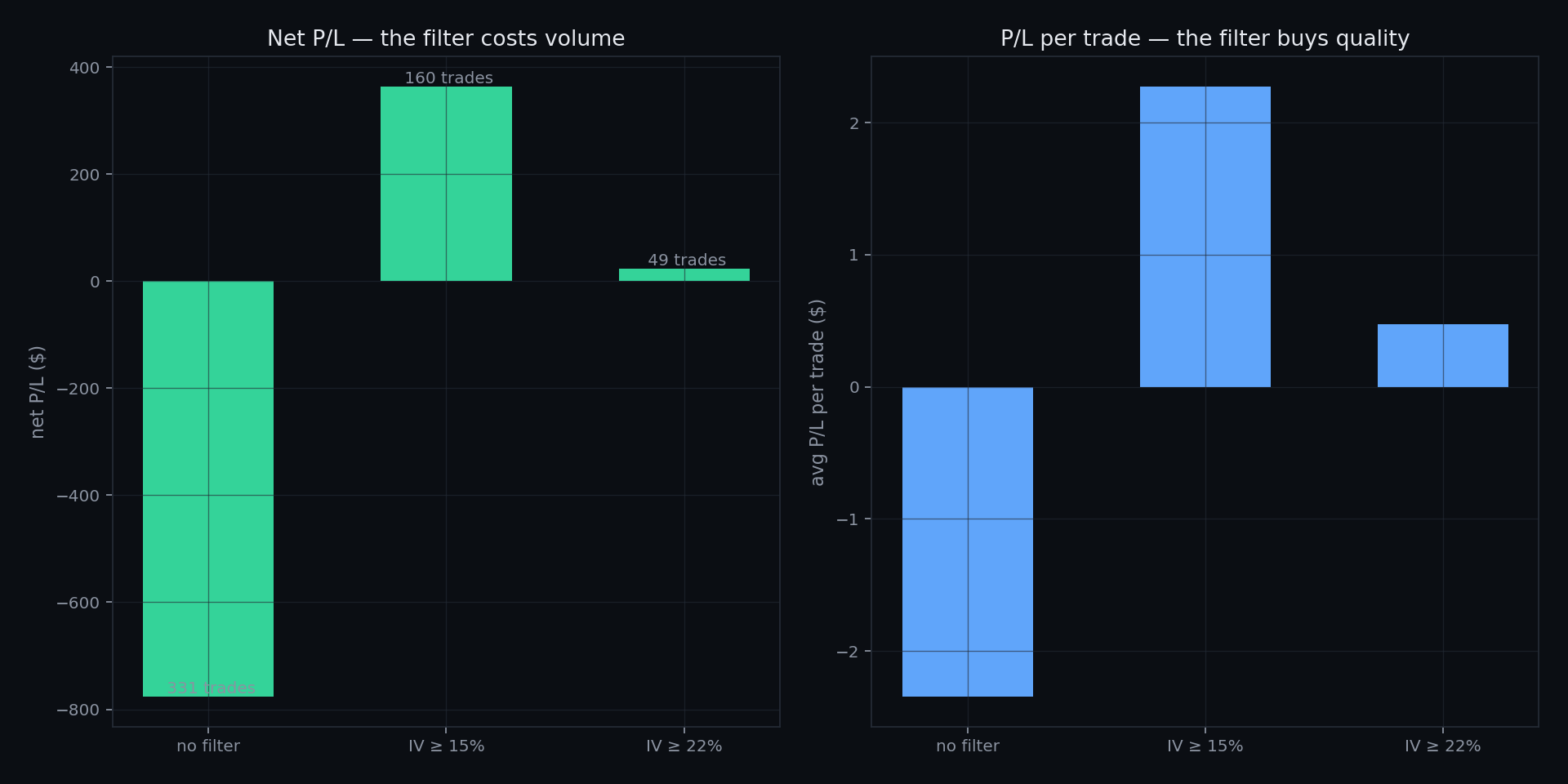
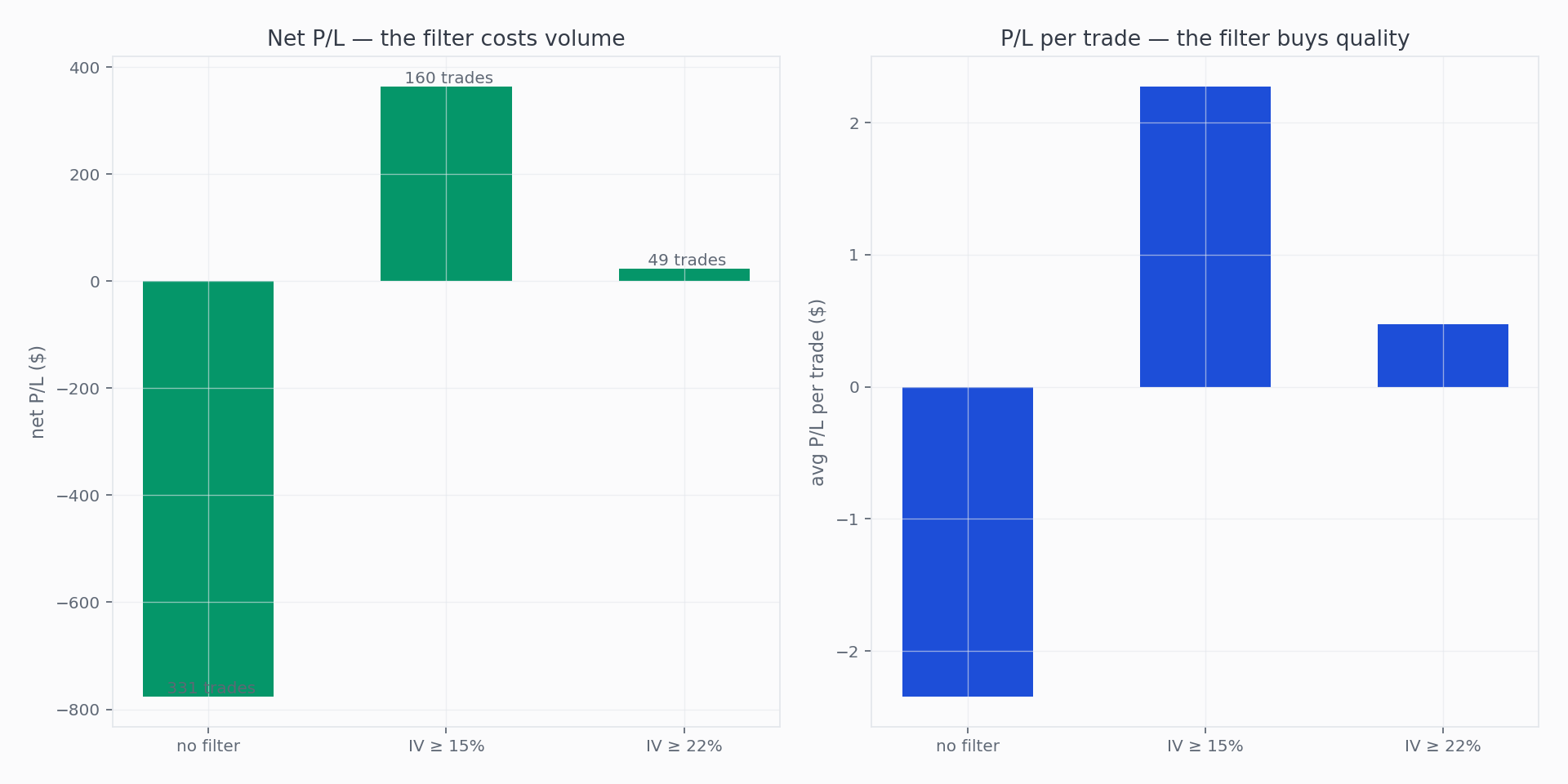
Under midpoint fills the IV gate was a preference — quality up, dollars down. Under realistic fills it is a rescue: the unfiltered baseline loses $776, the ≥15% gate turns the same strategy positive, and the mechanism is exactly the filter's two effects — fewer spread crossings, richer credit per crossing. Tightening further gives most of it back.
"Only sell premium when volatility is elevated" is the most repeated entry rule in the options-income world. The mechanism is sound — richer IV means richer credit for the same strikes — but a filter has a cost the folklore rarely prices: every day it rejects is a day the baseline strategy would have traded, and most of those days would have been winners (that's what a 74% win rate means).
Updated Aug 23, 2026 — Re-run under engine rev 3 — figures now include modeled fills. Tables show realistic (slipped fills — the headline) and optimistic (pure mid · reference only). See the methodology.
We took the best-quality arm from our DTE study — SPY put credit spreads, 0.30Δ, $5 wide, 45 DTE managed at 21 — and added one thing: an entry gate on the day's at-the-money implied volatility, at two thresholds.
Method
- Baseline: the unfiltered 45-DTE arm — 331 trades, 2013-04-01 → 2025-12-31, realistic net −$776 in the current revision.
- Filter arms: identical in every parameter, plus "enter only when ATM IV ≥ 15%" and "≥ 22%".
- A note on "IV rank": the popular formulation of this rule uses IV rank (today's IV relative to its own 1-year range). This study uses absolute IV, which is what the engine's entry filter evaluates. The question tested — does gating entries on elevated volatility earn its skipped days? — is the same; the cutoffs aren't directly comparable to rank-based ones.
- Skip accounting: days rejected by the filter are counted per reason in each run's summary, including days where IV itself wasn't available (an unknowable filter never silently passes).
End-of-day by design: like every OptionKrafter backtest, this study runs on daily bars — the resolution that keeps years of history reproducible and matches how rule-based options strategies actually trade — with full daily OHLC on the underlying, spread-priced fills on every leg, and both the realistic and pure-mid figure reported. Run under engine rev 3 (end-of-day). Windows from Apr 2023 now evaluate minute by minute; this study has not been re-run. How the engine models fills →
Results
| Setting | Trades | Days skipped by filter | Win rate | Net P/L (realistic) | Net P/L (mid) | Avg/trade | Max DD |
|---|---|---|---|---|---|---|---|
| No filter | 331 | — | 70.7% | −$776 | +$3,148 | −$2.34 | −$1,881 |
| IV ≥ 15% | 160 | 1,315 (+549 IV unavailable) | 73.8% | +$363 | +$2,977 | +$2.27 | −$932 |
| IV ≥ 22% | 49 | 2,091 (+720 IV unavailable) | 69.4% | +$23 | +$1,037 | +$0.47 | −$481 |
Realistic fills (0.66 of the spread per leg), no commissions; the mid column prices the same trades at the pure mid · same window and parameters as the DTE study’s 45-arm · trade counts shift slightly between revisions because exits trigger on slipped values.
Reading the trade-off honestly
Under midpoint fills, this study concluded the filter was a quality/volume dial — it always cost total dollars. Realistic fills change the conclusion, because the filter’s two effects both attack the exact thing that sank the baseline. Halving the trade count halves the number of times you pay 0.66 of the spread; gating on elevated IV raises the credit collected per crossing. Together they move the same strategy from −$776 to +$363. The second step up the threshold demonstrates the limit: at ≥22% the win rate and per-trade average fall back, and 49 trades in thirteen years keeps almost nothing (+$23) — a population small enough that its statistics are mostly noise anyway.
Two costs the headline table understates. First, the unavailable-IV days: in the early years of the archive, hundreds of entry days had no vendor-computed IV at all, and a filter strategy must skip them (545 and 725 days respectively) — a data-era cost that a modern-only backtest would never show. Second, capital idleness is not free: the filtered strategy holds nothing on skipped days. If idle capital could earn even a modest return elsewhere, the effective gap between the arms narrows — a dimension outside this test.
The honest conclusion moved with the fill model: at the midpoint the filter was a preference; under realistic execution it is the difference between a losing strategy and a barely-winning one. That is not because the filter found a bigger edge — the mid column shows it still costs optimistic dollars — but because trading less is itself the largest execution edge available to a retail-sized premium seller.
What this does not show
These are hypothetical, simulated results on historical data, filled under the engine’s disclosed execution model with no commissions or assignment costs. They are not a record of trading, and past behavior does not indicate future behavior. One underlying over one window is one sample, and 49 trades (the ≥22% arm) is a small population — its statistics carry wide error bars. Absolute-IV thresholds are regime-dependent: 15% was "elevated" in 2017 and "quiet" in 2022, which is precisely the argument rank-based formulations make; testing that variant is future work, not a footnote.
Reproducing this
Create the DTE study's 45-arm (SPY put credit spread, 0.30Δ short, $5 wide, PT 50%, stop 200%, time exit 21, daily entries, 2013-04-01 → 2025-12-31), then enable the IV entry filter at "at or above 15%", and again at 22%, and run each.